




You have decided to bring in external Power BI help. Good. Now comes the part where most organisations slow down, working out what kind of help to hire. If you want to hire a Power BI (or MS Fabric Consultancy) consultant, you have three realistic routes in the UK market, a contractor, a specialist consultancy or a big consultancy. The quick answer is this. A contractor is an extra pair of expert hands, they join your team and deliver a spec that was written for them in advance. A big consultancy and a specialist consultancy deliver the same thing (in most cases), ownership of the problem and the outcome. The real choice between those two is not what you get but how it gets delivered and that difference is what the rest of this blog unpacks.
A quick note on names, because the market is not consistent. In the UK we usually say contractor, elsewhere the same person is called a freelancer, and I will use both here. And the big firms get called agencies online, but in the UK nobody really calls them that, they are the big consultancies. Same three shapes, whatever you call them.
If you have not yet decided whether external help is needed at all, start with whether you need a Power BI consultant or in-house is enough. This blog assumes that decision is made.
Key takeaways before we get into it:
- Each option genuinely wins in some situations. Anyone telling you one option is always right is selling that option.
- A contractor supplies capacity inside your plan. A consultancy, big or specialist, takes ownership of the plan itself. That is the first fork in the decision.
- A big consultancy and a specialist consultancy usually deliver the same thing. The difference is how it gets delivered and who actually does the work.
- A hybrid model, external expertise building alongside your own people, often beats all three pure options.
- Whoever you hire, a good external partner leaves capability behind. Dependency is not a business model, it is a warning sign.
The three options, defined
Quick definitions, because these words get used loosely.
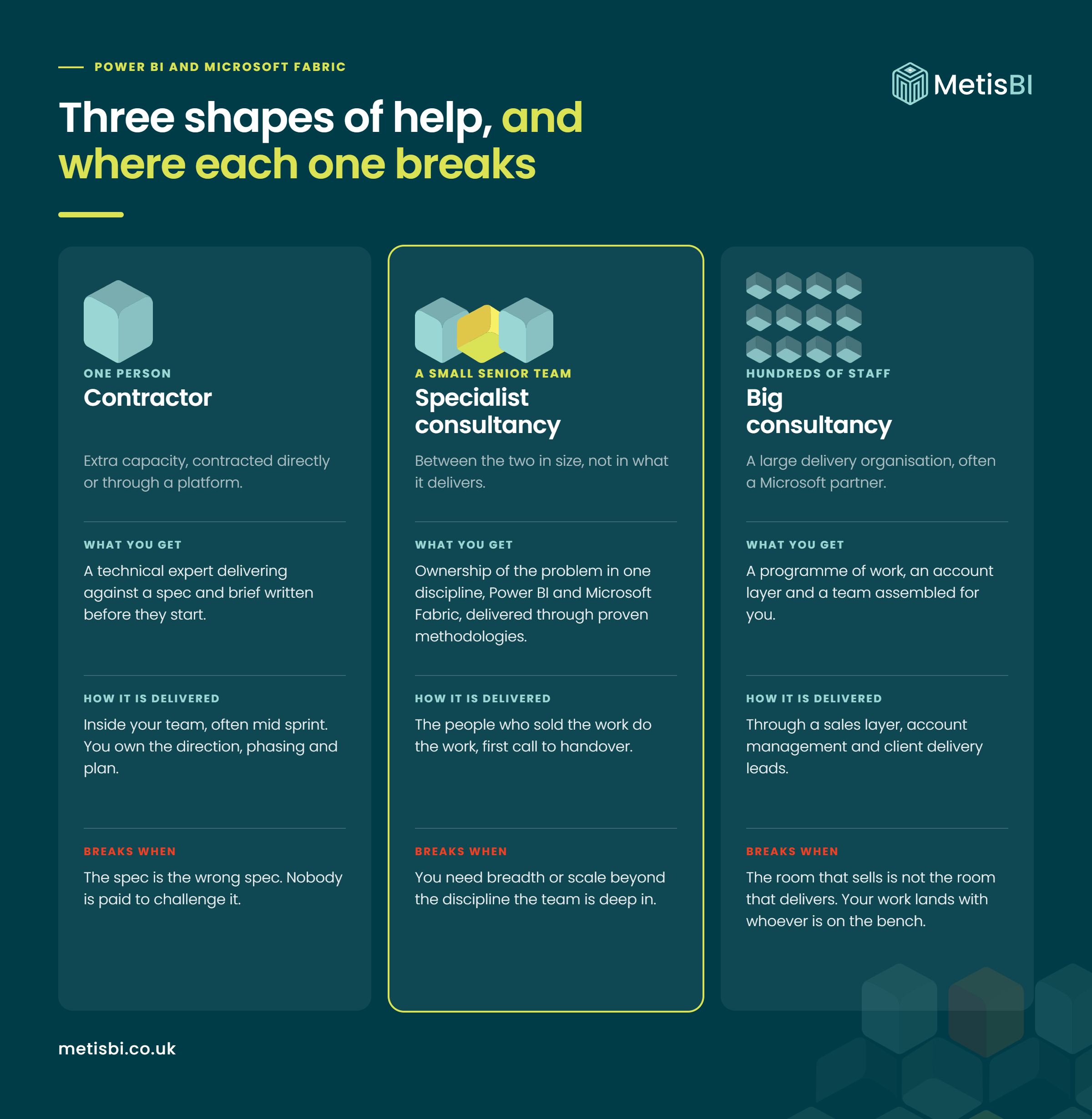
A contractor (or freelancer) is one person, usually a developer, contracted directly or through a platform, brought in as extra capacity. There is a clear contract, with the spec, brief and deliverables written for them in advance, which they sign before starting the work. They join your existing team, often mid-sprint, as a technical expert and get to work. You own the direction, the phasing and the plan, they deliver inside it.
A big consultancy is a large delivery organisation, often a Microsoft partner with hundreds or thousands of staff, selling programmes of work through a sales layer, account management, client delivery leads and plenty of people on the bench ready to join a project. Power BI is usually one line in a much wider service catalogue.
A specialist consultancy sits between the two in size, not in what it delivers. A small senior team focused on one discipline (in our case Power BI and Microsoft Fabric), taking the same ownership of the problem as a big consultancy, with the people who sold the work doing the work.
The lines blur at the edges, some contractors band together, some big firms have genuine specialists inside them. But as buying decisions go, these are the three shapes you are choosing between.
When a contractor works, and when it breaks
Let me be clear about the condition that makes this option work, because it is doing all the heavy lifting. A defined scope, a clear spec and an internal owner who knows what good looks like. That is not a nice to have, that is the whole model. Contractors come in and deliver the spec they are given. They do not usually arrive with a pre-written plan, a proven methodology or a way of shaping the work, because that is not what they are hired for, all of that was supposed to exist before they signed. When it does exist, a good contractor is fast, focused and cost-effective, extra build capacity inside a sprint, a short burst of specialist help inside a team that knows where it is going.
Where it breaks is everything around the build. I have inherited a fair share of contractor builds over the years and still to this day with Metis BI, and the pattern repeats. The report works, the model underneath follows no standard, nothing is documented and the person who understood it has moved to the next contract. One person means one point of failure, no challenge function (nobody to push back when the requirement itself is wrong), and no methodology beyond their personal habits. And when they leave, the knowledge leaves with them.
So the honest test is not "is this contractor good". The test is whether your organisation can supply everything the contractor does not bring, the plan, the spec, standards, direction, continuity and challenge.
When a big consultancy works, and when it breaks
At genuine enterprise scale, a big consultancy earns its place. Multi-region rollouts, hundreds of developers to coordinate, formal programme governance, and procurement rules that decide the shortlist before capability does, approved supplier lists, framework agreements, security vetting. If your Power BI programme is one workstream inside a wider transformation, the machinery is the point, not the overhead.
Where it breaks, in my experience, is the gap between the room that sells and the room that delivers. Since starting Metis BI, we have twice been brought in to help organisations that already had one of the Big 4 consultancies on the account. The pattern was the same both times. The firm wanted to win the project, then staffed it with whoever was sitting on the bench and not billable, regardless of whether they had the right skills. And it showed the moment we inspected the Power BI solutions, the underlying models and the Fabric implementation. Some even scramble to hire contractors at the last minute just to get the bid over the line.
I have also been in consulting for many years and I have seen the tricks. Juniors billed as seniors. Consultant level billed as principal. Time rounded up, never down. That is not every big firm, but the structure makes it possible, because the person you met in the sales cycle is rarely the person doing the work and every question routes through account management layers you pay for on every invoice.
None of that makes the big consultancies bad. It makes them built for a specific problem, scale and assurance and expensive in every other situation.
When a specialist consultancy works, and when it breaks
Here is the part I most want buyers to understand. A specialist consultancy delivers the same thing a big consultancy does. The difference is how, and who actually does the work. The people are senior, and they are usually involved from day one of the sales process all the way to the end, so the person who diagnosed your problem on the first call is the person solving it months later. No handoff to a delivery bench. Smaller consultancies also have a point to prove. There is no brand carrying us into the room, so the work has to.
Also because the discipline is narrow, the expertise is genuine and deep, not one line in a service catalogue. The unglamorous things that decide whether a solution lasts, the semantic model and its grain, the star schema underneath it, where logic should sit upstream, lakehouse or warehouse choices in MS Fabric, capacity, deployment pipelines, security. That is the work a Power BI consultancy and MS Fabric consultancy is actually for, and it is why we start most engagements with foundations and governance rather than only visuals.
A good specialist also arrives with proven ways of working, methodologies refined across many clients that fast track results whilst ensuring best practices are followed. Requirements gathering, modelling standards, delivery patterns. That is the machinery a contractor does not bring, without the layers a big consultancy charges for it.
The questions that actually decide it
Not a vetting checklist, that deserves its own guide and we have written one, how to choose the best Power BI consultancy. These questions come before vetting anyone. They tell you which shape of help to look for in the first place.
- How clear is the plan? If the spec, brief and deliverables are already written and you need hands to deliver them, a contractor fits. So does a specialist consultancy, report development against a clear spec is work we take on too, the difference is it arrives with standards and continuity built in. If writing them is the hard part, you need ownership of the problem and that points to a consultancy.
- What happens if it goes wrong? A low-stakes internal dashboard can tolerate a rebuild. Reporting that feeds board decisions or regulators cannot, and that risk is what methodology and continuity are for.
- Who owns it afterwards? If a capable internal team takes it over, buy the build. If nobody internally can own it, buy the capability transfer, not just the output.
- Do standards already exist? If naming, workspace structure and modelling standards are in place, an external developer can work inside them. If they do not exist, whoever you hire will invent them by accident, and you will live with those accidents for years.
And if the answers point to a consultancy, the final question is the one this whole blog turns on. Who will actually do the work, the people you met in the sales cycle or whoever happens to be free on the bench?
"A consultancy is just an expensive freelancer with a website"
I get versions of this a lot, always aimed at the specialist shape, and fair play for asking it out loud. Nobody looks at a firm of thousands and thinks that. It is the small consultancy that gets the question, because from the outside we can look like a contractor who incorporated. So here is the actual difference, and it is not the website.
Start with where specialist consultancies come from. The founders have usually spent years inside big tech or the big consultancies, and they bring all of that learning with them, minus the layers. That is why a good specialist runs proven, tried and tested methodologies, the same diagnosis, standards and delivery pattern on every engagement, refined across many clients. A contractor brings their personal way of working. That is what you are buying from a consultancy, repeatability, not just talent.
Continuity is the second difference. One person is one point of failure. A senior team means the knowledge of your estate does not walk out the door with a contract. And small does not mean informal. A proper specialist follows the same formalities the big consultancies do, a structured sales cycle, procurement, contracting, so the engagement aligns with your internal processes rather than working around them.
The last difference is the one we treat as the point of the job. A good consultancy embeds with your team rather than working separately in the background, and it leaves capability behind, standards documented, your developers trained and upskilled, decisions explained, so the engagement ends with your team stronger, not more dependent. A contractor can transfer knowledge too, but nothing in the model requires it. If you want to see how we hold ourselves to that, we have written up what sets Metis BI apart openly, and the client reviews behind it are independently verified on Clutch at 5.0, the feedback that earned recognition as a Top Power BI & Data Solutions Company in the UK for 2026.
If any of that is missing from a consultancy you are evaluating, then yes, you are looking at an expensive contractor with a website. Walk away.
The right question is not which option is best. It is which failure you cannot afford.
Metis BI sits deliberately in that specialist shape. We are a UK specialist Power BI and Microsoft Fabric consultancy, senior people only, involved from the first call to the final handover, and we take on the engagements where the problem needs ownership, unclear requirements, weak foundations, stalled adoption. If that sounds like where you are, our Power BI consultancy services page explains how we work. And if what you need is expert capacity inside an existing plan, hire a good contractor, genuinely.
Summary
There is no universally right way to hire external Power BI help, there is only the right shape for your situation. A contractor wins when the plan and spec already exist and you need expert capacity inside your own team. A big consultancy wins at genuine programme scale, where the machinery and the procurement boxes are the point. A specialist consultancy delivers the same ownership of the problem, through senior people who sold the work, do the work and stay to the end. Decide using plan clarity, risk, ownership after handover and whether standards exist, then ask the question this blog turns on, who will actually do the work. And remember the hybrid principle from the in-house or consultant question, the strongest organisations combine external expertise with growing internal capability. Whoever you choose, insist they leave you stronger than they found you.


.png)
.png)